
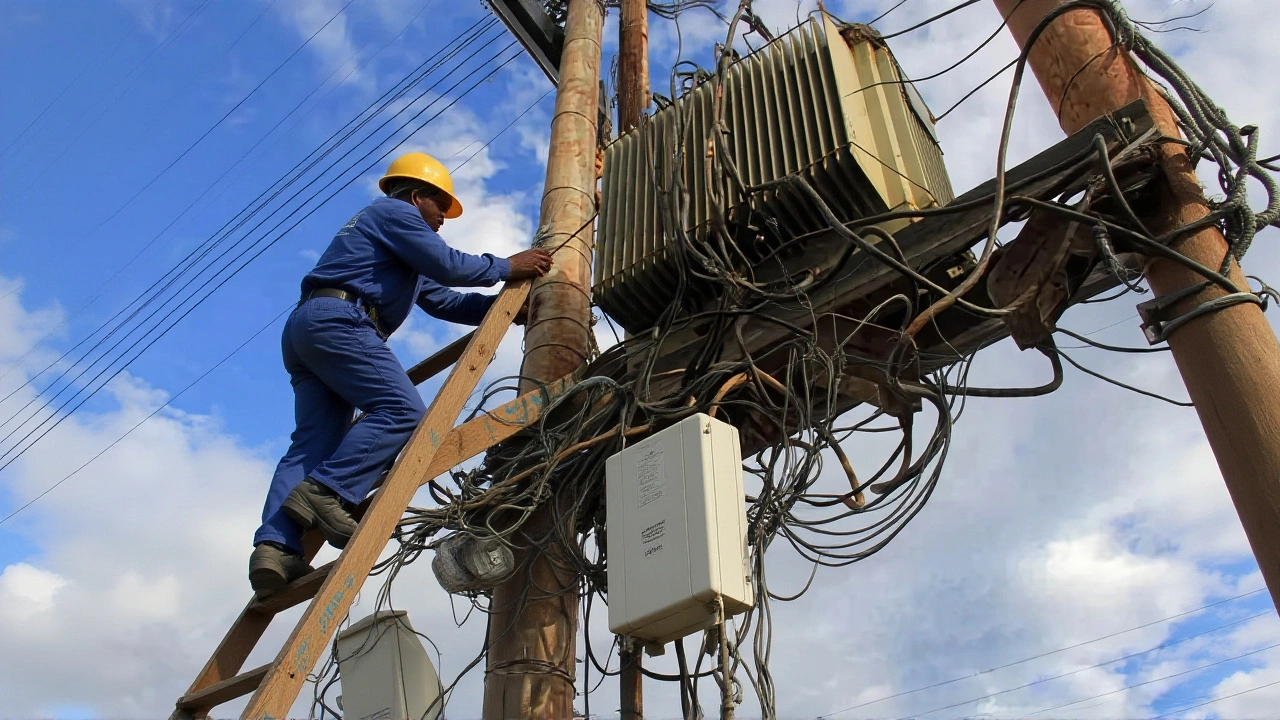
For millions of Kenyans who’ve lost work, spoiled food, or missed critical deadlines because of rolling blackouts, a long-overdue shift is coming. Under draft regulations released by the Energy and Petroleum Regulatory Authority (EPRA), Kenya Power and Lighting Company PLC will now be legally required to compensate customers for extended power outages — a first in Kenya’s electricity history. The Energy (Electricity Reliability, Quality of Supply and Service) Regulations, 2025, published in early 2025, don’t just nudge the utility toward better service — they make it pay for failure. And the stakes? High. Industrial users could see payouts running into hundreds of thousands of shillings per outage. Residential customers? They’ll get 75% of their average daily consumption value back — every time the lights go out without warning.
Why This Matters Now
Kenya’s grid has been sputtering for years. In the second half of 2024, system losses hit 24.2%, nearly 7 percentage points above EPRA’s legal limit of 17.5%. Monthly outages averaged 9.15 hours nationwide — nearly a full day of darkness per person, per month. That’s not an inconvenience. It’s an economic crisis. Small businesses shuttered. Hospitals scrambled to diesel backups. Factories halted production. The frustration wasn’t just loud — it was documented. EPRA received over 12,347 formal complaints about power quality in just nine months of 2024.
Here’s the thing: before this, the only consequence for Kenya Power was bad press. Now, there’s a financial penalty built into the system — one that hits the company where it hurts: its revenue. EPRA can now deduct unpaid fines and compensation directly from future tariff adjustments. No more delays. No more excuses.
How Compensation Works
The rules are precise. For residential and commercial users, any unplanned outage longer than 60 minutes triggers compensation. For factories, clinics, and data centers — the 30-minute threshold applies. And if an outage stretches beyond four hours? Automatic payout, no questions asked. The amount? 75% of the customer’s average daily usage in kilowatt-hours, multiplied by the current tariff rate. A household using 10 kWh daily? That’s 7.5 kWh worth of compensation. Multiply that by Kenya’s 8.4 million customers, and you begin to grasp the scale.
Industrial users aren’t just included — they’re prioritized. A textile mill in Thika losing eight hours of production could get over KSh200,000 in compensation. A pharmaceutical plant in Nairobi? Potentially more. The regulations explicitly acknowledge that for these businesses, downtime isn’t a cost — it’s a total loss of revenue, inventory, and contracts.
And here’s the kicker: compensation must be paid within 30 days of outage verification. No more waiting six months for a refund that never comes.
Fines, Audits, and Enforcement
It’s not just about paying customers back — it’s about preventing the outage in the first place.
- Failure to give 48 hours’ notice for planned outages? KSh1,000 per day, per incident.
- Delaying response to a consumer complaint? Another KSh1,000 per day.
- Supplying voltage outside ±10% for homes or ±5% for industry? A flat KSh500,000 fine per violation.
EPRA will conduct quarterly reliability audits of all licensed distributors — not just Kenya Power, but smaller retailers too. And if a utility fails? Their next tariff hike gets slashed until they fix it. This isn’t a warning. It’s a leash.
What’s Excluded — And Why It Matters
The rules aren’t blanket. Outages caused by storms, earthquakes, or sabotage? No compensation. Faulty wiring in your home? You’re on your own. Planned maintenance with proper notice? Also exempt. This isn’t about shielding consumers from all risks — it’s about holding the provider accountable for what they control. And Kenya Power controls most of it. With 95% of the distribution market, it’s the primary actor — and now, the primary target.
What’s interesting is what’s missing: no mention of digital metering or real-time outage tracking. That’s a gap. Without smart meters feeding live data to EPRA, verifying claims could become a bureaucratic nightmare. But the framework is there. The infrastructure? Still catching up.
A Historic Shift in Power Dynamics
Kenya Power, incorporated in 1952 and nationalized in 1995, has operated for decades with near-total control and little accountability. Customers paid their bills. They got power — sometimes. When they didn’t, there was no recourse. The draft regulations flip that script. They turn consumers from passive recipients into active claimants. For the first time, electricity isn’t just a service — it’s a contract with consequences.
This is also tied to Kenya’s broader Vision 2030 goal of 100% electricity access by 2030. You can’t promise universal access if you can’t guarantee reliable supply. These regulations are the enforcement arm of that ambition.
What’s Next?
The draft is open for public comment until August 2025. After that, it goes to Parliament for approval. If passed, implementation begins in January 2026. But even before then, Kenya Power is already feeling the heat. Internal memos obtained by local media show the company scrambling to upgrade transformers, hire more field crews, and revise its outage response protocols.
Experts say the real test will come during the next rainy season — when flooding and wind typically knock out lines. Will EPRA enforce compensation even when weather plays a role? The regulations say no — but if the pattern of outages spikes, public pressure might force a reevaluation.
One thing’s certain: Kenyans won’t go back to accepting blackouts as normal. This isn’t just regulation. It’s a cultural reset.
Frequently Asked Questions
Who qualifies for compensation under the new rules?
All registered electricity consumers — residential, commercial, and industrial — qualify if they experience an unplanned outage exceeding 60 minutes (or 30 minutes for industrial users). Compensation is calculated based on their average daily consumption over the past six months, multiplied by 75%. Outages caused by weather, consumer equipment failure, or properly notified planned maintenance are excluded.
How much could an industrial user receive per blackout?
Industrial users with high consumption — like a factory using 1,000 kWh daily — could receive up to KSh75,000 per outage if it lasts 30 minutes or more. If the outage exceeds four hours, compensation scales up significantly. Some large manufacturers have reported potential payouts exceeding KSh200,000 per event, based on 2024 tariff rates and production losses.
What happens if Kenya Power refuses to pay?
EPRA has direct authority to deduct unpaid compensation and fines from Kenya Power’s future revenue during tariff review cycles. This means if the utility doesn’t pay, it can’t raise prices. The regulator can also impose daily penalties of KSh1,000 for delayed complaints or unannounced outages, creating a powerful financial incentive to comply.
Will this lead to higher electricity bills?
Not directly. The compensation and fines are penalties for poor performance, not new charges. However, if Kenya Power fails to improve reliability, EPRA may block future tariff increases — which could pressure the company to invest more in infrastructure. Long-term, better service may reduce the need for costly diesel backups by businesses and households, effectively lowering overall energy costs.
How will outages be verified without smart meters?
EPRA will rely on customer reports, utility outage logs, and third-party monitoring systems. While smart meters would make verification easier, the regulations allow for manual verification through complaint records and historical consumption data. Kenya Power is required to maintain accurate outage logs — failure to do so triggers additional penalties. Over time, EPRA plans to phase in digital monitoring as part of the Vision 2030 grid modernization.
When will these rules take effect?
The draft regulations are open for public comment until August 2025. After parliamentary review and approval, they are expected to take effect on January 1, 2026. Until then, EPRA will conduct awareness campaigns and work with Kenya Power to prepare systems for compensation tracking and dispute resolution.


Author
Ra'eesa Moosa
I am a journalist with a keen interest in covering the intricate details of daily events across Africa. My work focuses on delivering accurate and insightful news reports. Each day, I strive to bring light to the stories that shape our continent's narrative. My passion for digging deeper into issues helps in crafting stories that not only inform but also provoke thought.